2-Piece Unicorn RC Car Set for Kids: Race & Story Play
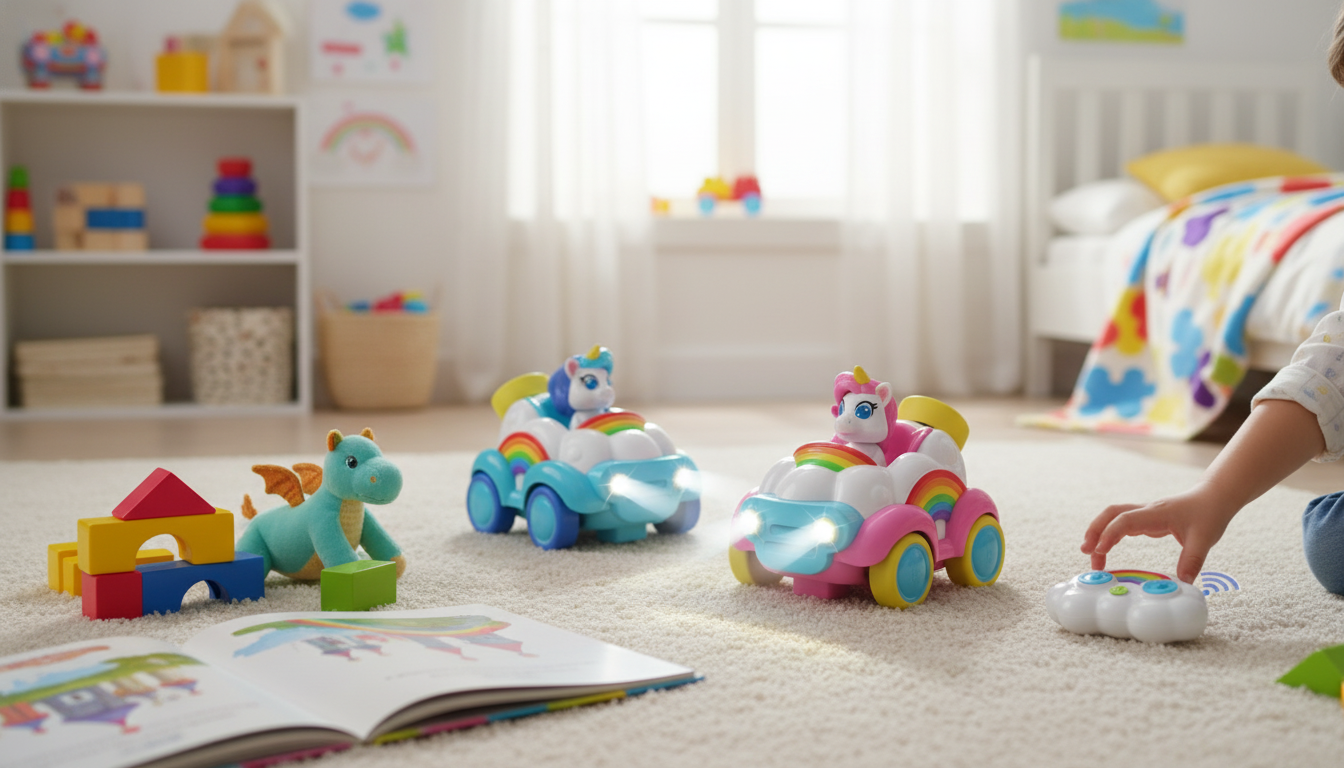
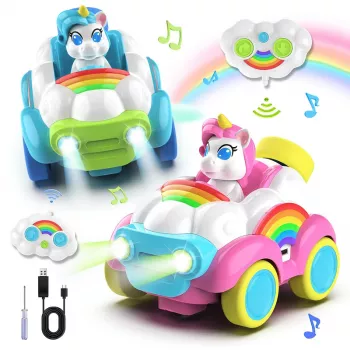
2-Piece Kids Remote Control Unicorn Car Set: Magical Racing Fun for Playtime
A unicorn-themed remote control car set blends the thrill of RC driving with bright, kid-friendly personality. With two cars ready to go, kids can race side by side, take turns without waiting, and turn simple driving into imaginative “missions.” Below is a practical guide to what usually comes with a two-car set, what to check for durability and ease of use, how to set everything up smoothly, and how to keep play safer indoors and outdoors.
What Makes a Unicorn Remote Control Car Set Special
A two-car unicorn RC set stands out because it’s designed for shared play. Two vehicles encourage friendly races, cooperative challenges, and natural turn-taking—without the common “one car, two kids” frustration. If one car needs a quick reset after bumping into a chair leg, the other driver can still keep moving, which keeps the energy up during playtime.
The unicorn theme adds more than decoration. Kids often turn the cars into characters and build storytelling around them—setting up “quests,” creating magical delivery routes, or inventing obstacle course “portals” with boxes and pillows. That imaginative layer can help extend play value beyond simple forward-and-back driving.
Remote control play also supports fundamentals like hand-eye coordination, timing, and spatial awareness. Kids learn cause and effect as they steer through tight turns, adjust speed, and judge distance before they bump a wall. And when both cars feel similar in responsiveness, races are more fun and feel fair for siblings and playdates.
Quick Look: What to Check Before Buying
Before choosing a two-car RC set, focus on age fit, play space, control simplicity, power needs, and build durability. Younger kids typically do best with straightforward directional controls and a speed that feels exciting but not chaotic. Older kids often prefer quicker response and tighter steering for more precise racing and challenge games.
Consider where the cars will be used most. Indoor play benefits from compact size and responsive turning, while outdoor play on patios or sidewalks usually needs better traction and a little more clearance. Durability details matter too—secure wheel mounts, reinforced bumpers, and a shell that resists scuffs help the cars survive everyday bumps.
Kid-Friendly Checklist for a 2-Car RC Set
| Feature to Verify | Why It Matters | What to Look For |
|---|---|---|
| Controls | Reduces frustration and improves confidence | Simple directional layout; easy-to-press buttons |
| Battery setup | Determines run time and convenience | Clear battery access; common battery sizes |
| Build quality | Helps the car last through bumps | Sturdy shell; wheels feel secure; smooth steering |
| Indoor vs outdoor traction | Prevents slipping or stalling | Tires with grip; stable driving on flat surfaces |
| Two-car play | Better for siblings and playdates | Cars that feel similarly responsive for fair racing |
How Kids Typically Play With a Two-Car Set
Two cars open up a lot of play patterns beyond “drive fast and crash.” Racing challenges are the obvious favorite: quick laps around cones, stuffed animals, or taped “lanes” on the floor help kids practice steering accuracy. Short, repeatable races also make it easier to take turns without arguments—especially if you rotate who starts first.
Obstacle courses are another hit. A few cardboard tunnels, a gentle slalom of cups, and a low, stable ramp can turn basic driving into a skill-building game. For unicorn-themed sets, “story mode” often becomes the main event: rescue missions, treasure runs, and “magic delivery” routes where kids decide the rules and the finish line.
As kids gain confidence, they often invent skill games: timed parking, stop-and-go challenges, or reverse-only rounds for extra difficulty. Co-op play works well too—one child drives while the other sets checkpoints and barriers, then they swap roles. That shared setup time can be just as fun as the driving.
Setup Tips for Smooth First-Time Use
A calm first setup makes a big difference in how much kids enjoy the set. Start on a flat surface with good lighting and install batteries carefully, matching the polarity markings. If the battery door uses a small screw, keep it in a small dish so it doesn’t disappear mid-setup.
Safety and Care for Remote Control Toys
Avoid wet surfaces unless the toy is clearly labeled as water resistant. For battery safety and general toy guidance, it helps to follow recommendations from trusted sources like the U.S. Consumer Product Safety Commission (CPSC) and the American Academy of Pediatrics battery safety guidance.
When This Set Makes a Great Gift
In-Stock Picks to Pair With Playtime
If you’re ready to add a unicorn racing set to your toy shelf, the 2-Piece Kids Remote Control Unicorn Car Set is an easy way to bring two-driver fun to indoor and outdoor play.
For older kids (or adults) who also enjoy screen-based play, a dedicated controller can make gaming sessions feel smoother and more comfortable. Consider the Wireless Silver Gaming Controller with Charging Dock for Switch, PC & iPad as a practical add-on for family game nights.
FAQ
What age is a remote control unicorn car set best for?
Younger kids usually do best with simple directional controls and slower speeds, plus adult supervision for battery compartments or small parts. Older kids often enjoy faster response and tighter steering for more challenging races and obstacle courses.
Can remote control cars be used indoors without damaging furniture?
Yes, with a clear play zone, soft barriers (pillows or foam), and lower-speed driving. Taped lanes and lightweight obstacles help guide cars away from delicate items, but repeated impacts can still cause scuffs over time.
How can run time be extended during play?
Keep spare batteries or rechargeables on hand, and turn cars off between rounds instead of letting them idle. Cleaning wheels and axles and using smoother surfaces can also reduce drag and help batteries last longer.















Leave a comment